

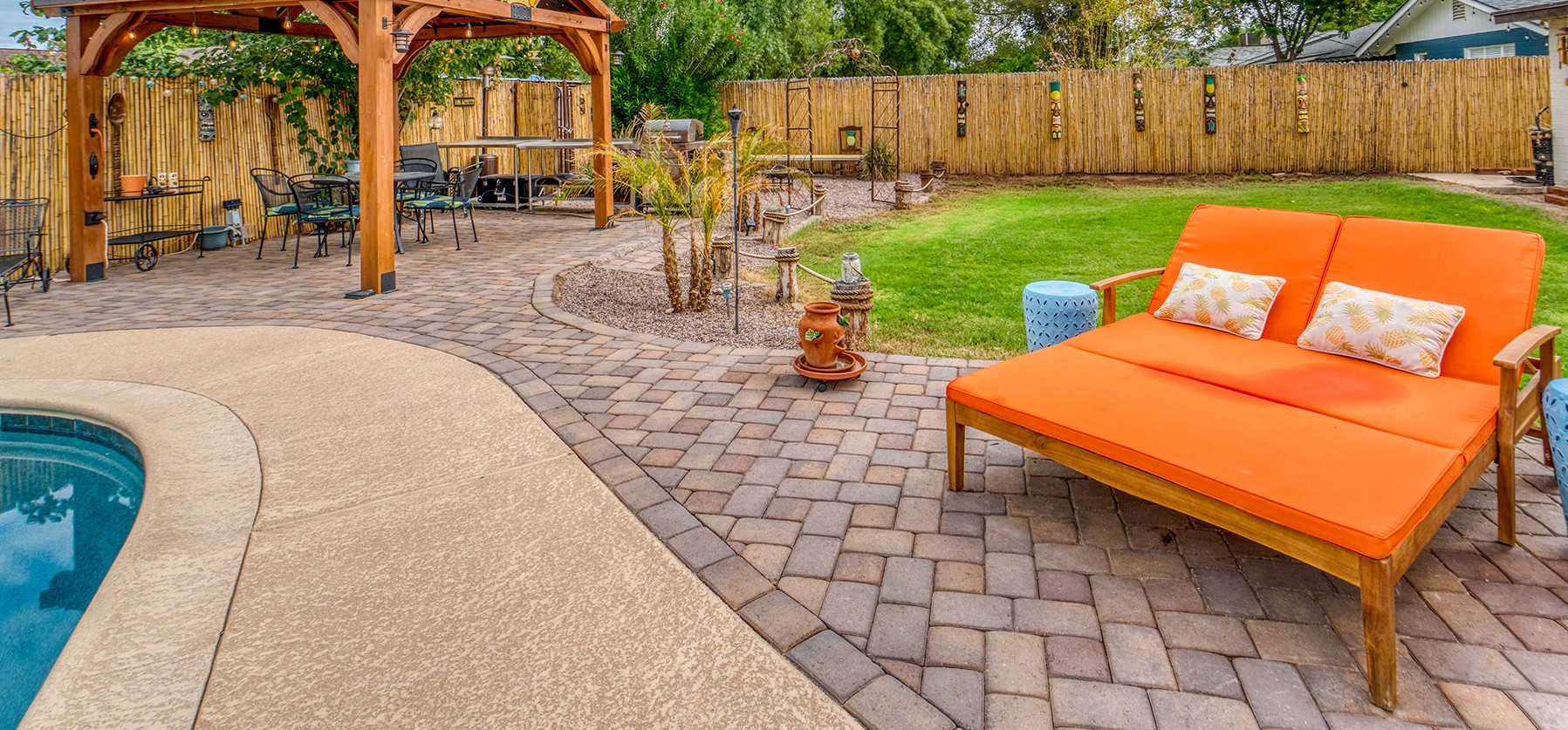
Outdoor living spaces in Southwest Florida are central to how we use our homes, but property layouts often limit the physical footprint of backyards. Whether you are dealing with a compact lanai in a new Wellen Park development or updating an older concrete slab in South Venice, a small patio can easily feel cramped once you add seating, a grill, or a pool cage.
You cannot change the property lines, but the geometry of your hardscaping can alter how the human brain perceives the boundaries of the yard. By selecting a specific paver layout, you can trick the eye into seeing expansive depth or width across a limited surface area.
The Power of Diagonals: The Herringbone Pattern
The herringbone pattern is the most effective layout for maximizing the perceived size of a small backyard. This pattern positions rectangular pavers—typically standard 4x8-inch dimensions—at interlocking 45-degree or 90-degree angles to create a continuous zigzag design.
For tight spaces in coastal areas like Nokomis or Casey Key, the 45-degree herringbone is the specific variation you want. When pavers run parallel to the walls of your home, the eye naturally measures the distance from the house to the edge of the property, instantly registering the small size of the patio. Pacing the pavers on a 45-degree diagonal shifts the perspective. The eye is forced to follow the staggered lines to the furthest corners of the yard, creating an illusion of greater width and depth.
Beyond the visual trick, herringbone is structurally superior for active outdoor spaces. The interlocking layout distributes weight evenly across the entire surface. If you plan to park a golf cart on the paver pad or place heavy outdoor kitchen equipment near the house, this pattern prevents individual blocks from shifting or sinking under heavy loads.
But there is a practical budget trade-off to consider before choosing this layout. Because the pattern runs on a diagonal, every edge where the patio meets a lawn, wall, or screen cage requires custom cuts. This increases the installation time and raises your material waste factor to roughly 10% or 15%, compared to the standard 5% waste required for simpler layouts.
Elongating the Footprint with Running Bond
If your backyard is wide but very shallow, or narrow like a side-yard dog run, the running bond pattern offers a clean, efficient alternative. This is a traditional brick-laying style where pavers are laid in parallel rows, with the joints of each row offset by exactly half a paver length.
Directional placement dictates how this pattern alters your space. If you lay the rows parallel to your home, the long horizontal lines draw the eye sideways, making a narrow yard feel much wider. If you rotate the rows so they run perpendicular to the house, the lines lead the eye outward toward the landscape, making a shallow backyard feel deeper. Running bond is highly efficient for tight budgets. It requires very few cuts along straight borders, meaning our installation crews can complete the job quickly, keeping your labor costs low and minimizing construction dust in your yard.
What to Avoid: The Gridlock of Stacked Bond and Basketweave
While complex patterns work well on sprawling driveways or large commercial pool decks in Osprey, they overwhelm a small backyard. You should generally avoid the stacked bond pattern—where square or rectangular pavers are lined up in a perfect, uniform grid. Grids act like a ruler for the eye; they make it incredibly easy for a visitor to subconsciously count the blocks and calculate exactly how limited the patio space is.
Similarly, the basketweave pattern, which pairs vertical and horizontal blocks to create alternating squares, introduces too many intersecting lines. This creates high visual noise that breaks the patio into tiny, distinct zones, making the overall footprint look smaller than it actually is.
A Quick Note on Drainage: Regardless of whether you choose a herringbone or running bond layout, compact patios enclosed by a pool cage or home structural walls leave no room for error with Southwest Florida downpours. Our installation crews calculate a precise 1/4-inch drop per foot of distance to slope torrential water away from your foundation, locking the pattern in place with stabilized polymeric sand to prevent joint washout.
Finalizing Your Outdoor Layout
Choosing a paver pattern requires balancing your budget, the architectural shape of your home, and the specific drainage needs of your property. If you want to see these interlocking patterns in person and compare different stone textures and color blends against your home's exterior paint, visit one of our showrooms in Sarasota, Bradenton, or Venice. When you are ready to map out your backyard transformation or need a precise estimate on material waste and installation timelines, contact us today to speak with an expert project coordinator.


